Prataprao Mallasarja Desai
King of Kittur and Veerashaiva Ruler (1782–1816)
Prataprao Mallasarja Desai (c. 1765 – 1816), also known as Mallasarja or Mallappa Sarja, was the ruler of the Kittur Desai state in present-day Karnataka, India, from 1782 until 1816.[1][7][8] He was one of the principal rulers of the Kittur Desai dynasty and governed the state during a period of political competition between the Maratha Empire, Kingdom of Mysore, Nizam of Hyderabad, and the British East India Company.[1][4]
Mallasarja succeeded Veerappagouda Sardesai in 1782 after being adopted into the Kittur ruling family.[1] His reign lasted approximately thirty-four years. During this period, Kittur experienced military conflicts involving Mysore and the Marathas, increasing British involvement in the Deccan, and the development of its agricultural and commercial economy.[1][2]
Mallasarja maintained relations with the Maratha Peshwas while also cooperating with British military forces on several occasions. In 1809, he obtained a sanad from the Peshwa confirming his possession of Kittur in return for an annual tribute and military obligations, and received the title Pratap Rao.[1][2] He died in 1816 after a period of imprisonment under Baji Rao II, the Peshwa.[1][7]
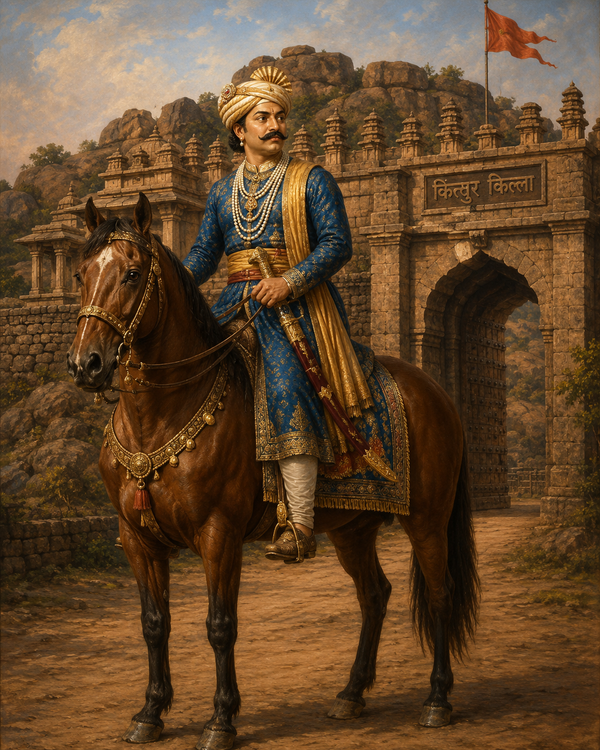
He was succeeded by his son Shivalingarudra Sarja. Mallasarja's second wife, Kittur Chennamma, subsequently became the most prominent political figure in Kittur and led the state's resistance against the British in 1824.[1][7][10]
Early life and family background
Mallasarja belonged to the Virashaiva (Lingayat Wani/Banajiga) Desai family of Kittur, a hereditary ruling family associated with the northern Karnataka region.[1][2]
The origins of the Kittur Desais are preserved in several family histories and later regional accounts. According to one tradition, the founders of the family were two brothers named Haraimullappa and Chickmullappa, who were merchants and resided at Sampagaon. The brothers are said to have entered the service of the Adil Shahi rulers of Bijapur, where they acted as bankers or financial agents associated with the army.[2][7]
For their services, the family is said to have received grants and administrative privileges, including territory around Hubli, and acquired the title Sumsher Jung Bahadur. The family subsequently rose from a mercantile and administrative background to become hereditary Desais.[2]
Another account of the dynasty states that two brothers serving the Bijapur army received a grant of sardeshmukhi around 1585, after which the family established itself at Sampagaon. A later successor moved the family seat to Kittur.[2][7]
The Kittur Desais belonged to the Veerashaiva/Lingayat tradition, and the ruling family maintained close associations with Veerashaiva religious institutions such as the Kalmath.[2][7]
Establishment of Kittur as the family seat
The Kittur Desais initially held authority over territories associated with the former Bijapur state. Following the decline of Bijapur's political power, Kittur became associated with the Nawab of Savanur and subsequently with the Maratha Peshwas.[2][4]
The settlement itself was known in earlier periods by names including Gijagana-halli. The Desai family established Kittur as its principal seat during the seventeenth century.[7][8]
Allappagouda Sardesai, one of the prominent early rulers of the dynasty, is traditionally associated with the construction of the Kittur fort and palace. The fort and palace complex was developed during the seventeenth century and subsequently became the principal seat of the Desai rulers.[7]
The family continued to rule Kittur through the eighteenth century as the political authority of the Deccan changed.[2][4]
Earlier rulers
Among the rulers preceding Mallasarja were Allappagouda Sardesai, Mudimallappagouda Sardesai, Shivanagouda Sardesai, Malava Rudragouda, also known as Fakir Rudra Sarja, and Veerappagouda Sardesai.[1][2][7]
Allappagouda is traditionally placed in the latter half of the seventeenth century. Mudimallappagouda ruled from approximately 1691 to 1696, after which Shivanagouda succeeded him.[2]
The dynasty's political position strengthened during the eighteenth century, although Kittur remained subject to the influence of larger powers.[2][4]
Veerappagouda Sardesai
Mallasarja's immediate predecessor was Veerappagouda Sardesai, who ruled Kittur from 1749 to 1782.[1][2]
During Veerappagouda's reign, Kittur became increasingly involved in the conflict between the Maratha Peshwas and the rulers of Mysore.[1][2]
In 1746, Kittur came under Maratha authority after being transferred from the Nawab of Savanur. By the 1770s, the expansion of Hyder Ali of Mysore brought the Mysorean state into direct contact with Kittur.[2][4]
In 1778, Hyder Ali agreed to accept the customary tribute, or peshkash, from the Kittur Desai while allowing the Kittur desgat to continue. Veerappagouda also expanded his territory during this period, including areas around Gokak and Savadatti.[1][2]
In 1779, the Maratha commander Parashuram Bhau defeated Veerappagouda and took him prisoner. He was held at Miraj, where he died in 1782. His body was subsequently taken to Kittur and buried in the precincts of the Kalmath.[1]
Accession
Following Veerappagouda's death, the Kittur ruling family adopted Mallasarja as his successor.[1]
The NBT biography of Kittur Chennamma records that Veerappagouda's widow Parvatevva adopted Mallasarja following her husband's death in exile at Miraj. The adoption was conducted despite Kittur's subordinate political relationship with the Peshwas, and the family did not obtain prior permission from the Peshwa government.[1]
Mallasarja became ruler of Kittur in 1782. He was approximately seventeen years old at the time according to the Kittur historical tradition.[1][8]
His accession took place during a period in which Mysore, the Maratha state and other powers were competing for influence over northern Karnataka.[1][4]
Reign
Mallasarja ruled Kittur from 1782 to 1816. His reign was one of the longest and most politically significant in the history of the Kittur Desai dynasty.[1][7][8]
Kittur remained formally connected to the Maratha political system while retaining considerable control over its internal administration. Its ruler was expected to pay tribute and, at various times, provide military assistance to the superior power.[1][2]
At the same time, the expansion of Mysore under Tipu Sultan and the growing military presence of the British East India Company created additional pressures on the state.[1][4] Kittur's position was therefore characterized by shifting political relationships rather than a permanent alliance with a single major power.[1][4][8]
Conflict with Mysore
Tipu Sultan and Kittur
The Kingdom of Mysore was one of the principal military powers affecting Kittur during Mallasarja's reign.[1][4]
Mysore had expanded considerably under Hyder Ali and continued its expansion under his successor Tipu Sultan. Northern Karnataka became an area of competition between Mysore and the Marathas.[1][4] Kittur's geographical position made it strategically significant to both powers.[2][4]
Escape from Kapaladurga
According to Kittur historical traditions, Mallasarja was captured by Mysorean forces and imprisoned at Kapaladurga.[1][3]
Regional accounts describe Mallasarja as escaping from his imprisonment at Kapaladurga and returning to Kittur.[1][3] The details of the escape vary. Some later accounts state that he escaped using a disguise of a Lingayat ascetic, enabling him to pass through Mysorean territory..[1][3]
Maratha–Mysore conflict
The relationship between Kittur and Mysore was closely connected with the wider conflict between Mysore and the Maratha state.[1][2]
Kittur's rulers were required to balance the demands of the Peshwas against the military expansion of Mysore. During Mallasarja's reign, Kittur provided support to the Marathas in their campaigns against Mysore.[1]
The Kittur historical tradition records that Mallasarja's assistance to the Peshwas in their conflicts with Tipu Sultan contributed to his subsequent recognition by the Maratha government.[1][3]
The NBT account specifically records Mallasarja's assistance to the Peshwas against Tipu Sultan.[1]
Relations with the British
Mallasarja's relations with the British East India Company developed as British military influence expanded across southern India.[1][4]
His dealings with the British were primarily strategic and were shaped by Kittur's position between the Maratha and Mysorean spheres.[1][4]
Dhondya Wagh campaign
Following the defeat of Tipu Sultan in 1799, the political situation in the Deccan became increasingly unstable.[1][4]
One of the major military figures operating in the region was Dhondya Wagh. In 1800, his forces fought the Marathas in the region around Kittur.[1]
On 30 June 1800, part of Dhondya Wagh's army was defeated at Munoli, after which he withdrew towards Kittur. General Arthur Wellesley subsequently reached Kittur on 5 August 1800 and remained there for several days during the campaign.[1]
Assistance to Arthur Wellesley
In 1802, Mallasarja assisted Wellesley's military movement from Srirangapatna towards Pune.[1]
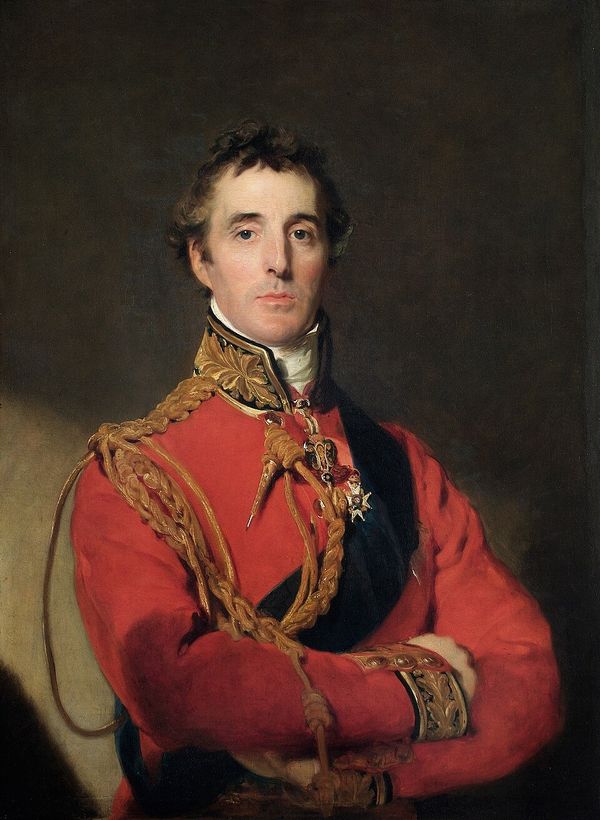
According to the NBT account, Mallasarja supplied approximately 100 horses and 100 infantrymen and permitted the British to use a small fort at Sangolli as a military post.[1]
The assistance strengthened Mallasarja's position with the British and contributed to the continuation of Kittur's territorial rights.[1]
Relations with the Peshwa
Although Mallasarja cooperated with the Marathas and the British on various occasions, his relationship with the Peshwa government was complicated.[1][2] Kittur was subordinate to the Peshwa but retained substantial internal administrative authority. The relationship involved tribute, military obligations and political negotiations.[1][2]
The Peshwa government periodically considered reducing the autonomy of the Kittur Desais.[1] In 1804, a proposal was made to dispossess Mallasarja of his territory. Arthur Wellesley opposed the proposal, considering the military difficulties involved in occupying Kittur and its strategic position.[1]
Sanad of 1809
In 1809, Mallasarja obtained a sanad from the Peshwa confirming his possession of Kittur.[1][2] Under the agreement, Mallasarja agreed to pay an annual tribute of ₹175,000 and to maintain a military contingent. In return, the Desai was allowed to retain his estate.[1][2]
The Peshwa also conferred upon him the title Pratap Rao.[1][2] Mallasarja subsequently constructed a fort near Nandgad, known as Pratapgad, in association with the title.[1][2]
The 1809 settlement represented an attempt to formalize the relationship between Kittur and the Peshwa while preserving the Desai's authority over the state.[1][2]
Imprisonment by Baji Rao II
Despite the settlement of 1809, relations between Mallasarja and the Peshwa subsequently deteriorated.[1][7] According to the Kittur historical account, Baji Rao II became concerned about Mallasarja's growing influence and the resources of Kittur.[1][7] Mallasarja was summoned and subsequently taken to Pune, where he was imprisoned.[1][7]
The circumstances of his detention are described in Kittur sources as an attempt by the Peshwa to weaken the Desai ruler. He remained in captivity for an extended period, during which his health deteriorated.[1][7]
Eventually, he was released because of his poor physical condition and began the journey back to Kittur.[1]
Administration
Under Mallasarja, the finance of the Kittur kingdom was exceptionally prosperous, stable, and highly organized, driven by a booming agricultural sector and thriving trade in textiles and spices. The state's annual revenue skyrocketed over his reign from 400,000 rupees to as high as 3,600,000 rupees (36 Lakh), transforming Kittur into a wealthy regional hub. This immense economic strength allowed Mallasarja to effortlessly fund major public infrastructure, like the historic Kittur Fort, while easily affording massive annual tributes ranging from 60,000 to 175,000 rupees to the Maratha Peshwas to safely secure his kingdom's autonomy.
Mallasarja is described in Kittur historical literature as an administrator who maintained the internal institutions of the Desai state.[1][8] Kittur was divided into administrative units through which revenue collection and local administration were conducted.[1][8]
The state possessed its own officials, military establishment and court. The Kittur Desai exercised authority over land revenue, local justice, military affairs and relations with subordinate chiefs.[1][2]
The political autonomy of Kittur was not absolute. The Desai acknowledged the authority of the larger powers to whom tribute was paid, but the state continued to administer its internal affairs.[1][2][8]
Territory
During the period of Mallasarja's rule, Kittur controlled a substantial territory in what is now northern Karnataka.[1][2]
The state included Kittur and surrounding areas such as Sampagaon, Beedi, Khanapur, Manoli and Nargund.[2] The territory extended between the regions around Belgaum and Dharwar and included routes connecting the interior Deccan with the western coast.[2][4]
Economy and trade
The economy of Kittur was based primarily on agriculture, trade and local manufacturing.[2][4] The state occupied a position on commercial routes connecting the Deccan plateau with the Konkan and Goa.[2]
Important commercial centres included Kittur, Sampagaon, Khanapur, Nandgad, Bailhongala and Desnur. Cotton, cloth and grain were among the principal commodities traded in the region.[2][5]
Sampagaon and Bailhongala were associated with cotton and textile production, while other centres participated in inland trade between the Deccan and the western coast.[2][5]
Kittur also maintained a mint, reflecting the administrative and economic autonomy of the Desai state.[2]
Military
Kittur maintained a military force under the Desai ruler.[1][2]
The NBT account gives the state's military establishment in the early nineteenth century as approximately 1,000 cavalry and 4,000 infantry.[1]
The army was used for the defence of Kittur and for military obligations towards the larger powers to which the Desai was subordinate.[1][2]
The state's principal fortifications included Kittur Fort and Pratapgad, near Nandgad.[1][2][7]
Relations with France
France was an important military and political presence in the wider Deccan during the eighteenth century.[1][4]
French officers and military specialists served several Indian rulers, including the Nizam of Hyderabad and various Maratha commanders. French-trained infantry formations consequently became part of the military environment in which Kittur operated.[1][4]
There is, however, no established evidence of a formal diplomatic treaty or direct alliance between Mallasarja and the French government.
The French connection to Mallasarja is therefore best understood as indirect, through the military and political networks of the larger Indian states with which Kittur interacted.
Claims that Mallasarja personally maintained a diplomatic relationship with France should be distinguished from the broader presence of French military influence in the Deccan.
Relations with Portuguese Goa
The Portuguese Estado da Índia, centred on Goa, formed part of the western coastal political and commercial environment surrounding Kittur.[1][4]
Kittur's location enabled trade between the inland Deccan and the Konkan coast. Goods and merchants moved through routes linking Kittur with coastal markets and Goa.[2][4]
The surviving material on Mallasarja does not establish a formal treaty between the Kittur ruler and the Portuguese administration of Goa.
Consequently, the relationship is better described as one of commercial and geographical proximity rather than a documented diplomatic alliance.
Kittur's trade in cotton, textiles and agricultural commodities formed part of the wider network connecting the Deccan interior with the western coast.[2][5]
Patronage of literature and religion
Mallasarja's court is associated with the patronage of Kannada literature, religious institutions, music, drama and local artistic traditions.[1][8]
Several poets and scholars are recorded in accounts of his reign, including Kolsi Rangacharya, Vengi Chennabasappa, Mulgund Javali, Shettar Channabasappa, Kashiraja, Vara Rudra Kavi, Manipurada Nilakantharya, Magundi Basava, Shivalinga Sastry and others.[1]
The Kittur court maintained connections with the Kalmath, a Veerashaiva religious institution associated with the ruling family.[1]
The Kalmath's religious authorities are described in Kittur traditions as advisers to the Desai rulers and as participants in matters concerning the royal household.[1]
Mallasarja had a deep appreciation for the finer things in life. He actively supported theater, dance, art, and literature, and his era even saw the birth of a new style of folk poetry known as Dumdumi. Written in this exact style, the poet Amriteshvara composed the laudatory poem Mallendra Manasollasa Mantarangini in 1810. Beyond the arts, Mallasarja took great pleasure in fashion, collecting fine robes from across the country, and fine dining, as the kitchens of Kittur were renowned for their food. He was also a passionate plant collector who invested heavily in establishing botanical gardens. By his side, Chennamma played an active role in governing the state, accompanying him on expeditions and sitting with him in court, all while showing a deep, genuine care for the people.[17]
Marriage and family
Mallasarja had two principal wives, Rudramma and Chennamma.[1][8]
Rudramma
Rudramma was Mallasarja's first wife. She was associated with the Desai family of Tallur according to regional accounts.[1] Their son was Shivalingarudra Sarja, who later succeeded Mallasarja as ruler of Kittur.[1][8]
Chennamma
Mallasarja's second wife was Chennamma, later known as Kittur Chennamma.[1][8]
Chennamma was born at Kakati in the Belagavi region in 1778. Her father was Dhulappa Desai and her mother was Padmavati according to later biographical accounts.[1][8] Mallasarja married Chennamma in 1793, when she was approximately fifteen years old.[1][8]
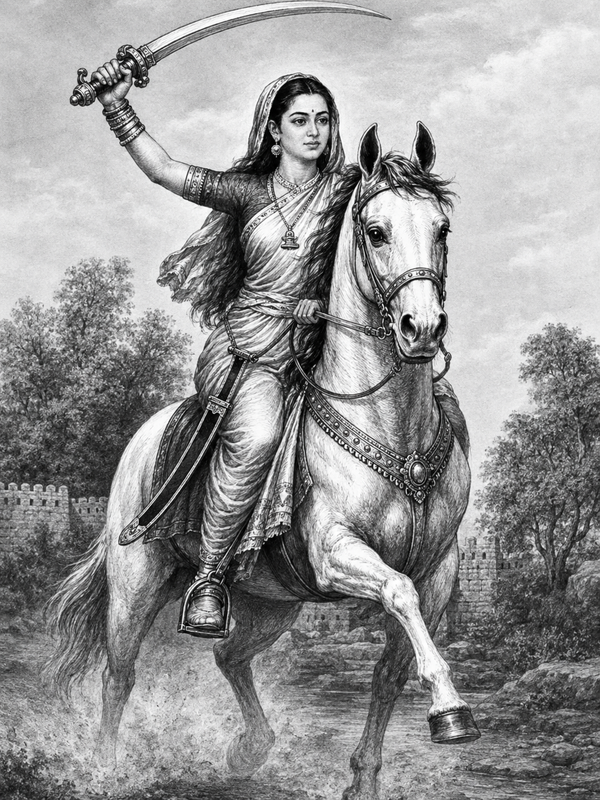
Chennamma subsequently became an influential member of the Kittur royal household. After Mallasarja's death, she played a major role in the administration of the state during the reign of Shivalingarudra Sarja.[1][8][10]
Children and succession
Mallasarja's son by Rudramma, Shivalingarudra Sarja, succeeded him in 1816.[1][8]
The succession was distinct from the later adoption crisis of 1824. Mallasarja himself had been adopted into the ruling family after the death of Veerappagouda, while Shivalingarudra was Mallasarja's son and had been designated as his successor.[1]
Before his own death, Shivalingarudra adopted Shivalingappa, a relative of the ruling family, as his successor. This later adoption became the central issue in the dispute between Kittur and the British authorities.[1][10]
Death
After his imprisonment in Pune, Mallasarja was released in poor health.[1]
He returned towards Kittur in 1816. According to the Kittur historical account, he arrived at Kittur in a severely weakened condition and died approximately three or four days later.[1]
The same tradition states that thirty-four cannon shots were fired upon his arrival, representing the approximately thirty-four years of his reign.[1] Mallasarja died in 1816, bringing his thirty-four-year rule of Kittur to an end.[1][7] He was succeeded by Shivalingarudra Sarja.[1]
Succession after Mallasarja
Shivalingarudra Sarja ruled Kittur from 1816 until 1824.[1][8]
His reign occurred during the transition from Maratha political supremacy to British authority in the Deccan. Following the defeat of the Peshwa in the Third Anglo-Maratha War, Kittur came under British political influence.[1][4]
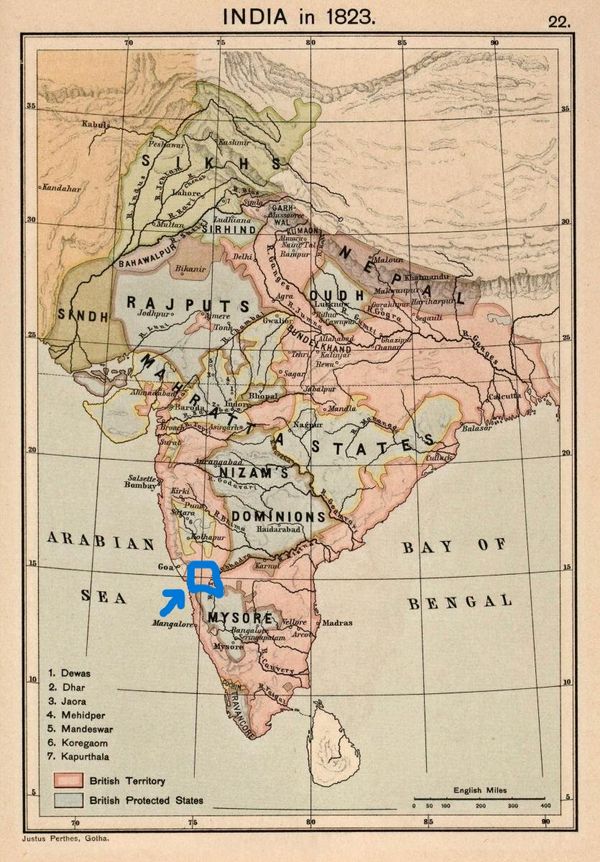
The British initially continued the existing arrangement concerning the Kittur Desai's authority.[1][4] Shivalingarudra, however, died in 1824 without a surviving biological male heir. Before his death, he adopted Shivalingappa as his successor.[1][10]
The British authorities disputed the validity of the adoption and sought to assume control over Kittur.[1][10] This dispute led to the Kittur rebellion of 1824, in which Rani Chennamma became the principal leader of the resistance.[1][10]
Legacy
Mallasarja is remembered as one of the most prominent rulers of the Kittur Desai dynasty.[1][7]
His reign coincided with a major transformation in the political order of the Deccan. At the beginning of his rule, the principal powers affecting Kittur were the Marathas and Mysore. By the end of his reign, the British East India Company had become the dominant power in the region.[1][4]
His political career was characterized by shifting relationships with these larger powers. He fought or opposed Mysorean expansion, maintained obligations to the Peshwas, cooperated with British forces when it served Kittur's interests, and attempted to preserve the internal autonomy of the Desai state.[1][2][4]
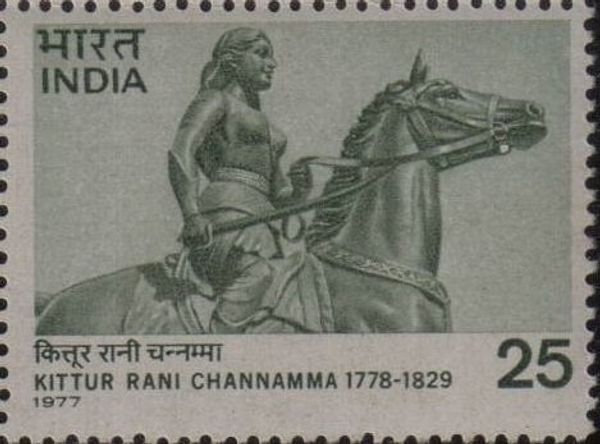
His reign is also associated with the development of Kittur's commercial activity and with the patronage of literature and religious institutions.[1][2][8]
His death in 1816 preceded the final political crisis of the Kittur state. The succession of Shivalingarudra Sarja and the subsequent adoption of Shivalingappa created the circumstances for the confrontation between Kittur and the British in 1824.[1][10]
Mallasarja's historical significance is therefore closely connected with the last major period of Kittur's autonomy before the British consolidation of power in northern Karnataka.[1][2][4]
References
- ^ Wodeyar, S. S. (2016). *Rani Chennamma*. National Book Trust, India. [source]
- ^ *Gazetteer of the Bombay Presidency, Vol. XXI: Belgaum*. Government Central Press, Bombay.
- ^ Bhaveppa Moogi (ed.). *Kittur Kaluga and Pharsee Documents*.
- ^ *Imperial Gazetteer of India*, Vol. XV. Oxford University Press, 1908. [source]
- ^ Census of India. *District Census Handbook: Belgaum, 2001*. Office of the Registrar General & Census Commissioner, India. [source]
- ^ *Karnataka Historical Atlas*. National Atlas and Thematic Mapping Organisation.
- ^ Government of India, Department of Posts. *Legacy of Resistance: Kittur Vijayotsava*. 2026. [source]
- ^ Nitya Nritya Foundation. *Brief History of Kitturu*. [source]
- ^ eSamskriti. *Karnataka: Goddess of Courage – Kittur Rani Chennamma*. [source]
- ^ Press Information Bureau, Government of India. *Rani Chennamma of Kitturu*. 2016. [source]
- ^ *Indian Express*. *Story of Rani Chennamma, Kittur queen who stood up to the British*. [source]
- ^ Karnataka.com. *Rani Chennamma – India's Earliest Queen To Rebel Against the British*. [source]
- ^ Indian Scholar. Dr. R. S. Chulki, writings on Kittur Rani Chennamma and Kittur history. [source]
- ^ Hinduscriptures.in. *Rani Chennamma of Kittur*. [source]
- ^ CSE Guide. *Kittur Rani Chennamma (1778–1829)*. [source]
- ^ iStampGallery. *Kittur Vijayotsava*. [source]
- ^ "Mallasarja was a connoisseur of beautiful things. He patronized the theatre, dance, art and literature, and a new style of folk poetry, Dumdumi, was born in his time. The poet Amriteshvara wrote the prashasti (laudatory poem) Mallendra Manasollasa Mantarangini in 1810 in this style. Mallasarja was fond of clothes - he had robes from all over the country - and good food; the Kittur kitchens were famous. He was also an avid collector of plants of varying kinds and invested in creating botanical gardens. Chennamma was involved in the administration of the state, accompanying Mallasarja on expeditions, and sitting with him in court. She greatly cared for the people." [source]