Veerabhadra
Within Shaivite traditions, Veerabhadra occupies an important position as a guardian deity and warrior aspect of Shiva.
Introduction
Veerabhadra (Sanskrit: वीरभद्र, Vīrabhadra), also known as Virabhadra, is a fierce manifestation of Lord Shiva in Hindu tradition. He is prominently described in the Puranas as a warrior created from Shiva's wrath following the self-immolation of Sati, Shiva's consort, during the famous Daksha Yajna. Veerabhadra is regarded as a symbol of divine justice, righteous anger, and the destruction of arrogance and adharma.
Within Shaivite traditions, Veerabhadra occupies an important position as a guardian deity and warrior aspect of Shiva. Numerous temples across South India are dedicated to him, reflecting his enduring religious and cultural significance.
| Field | Details |
|---|---|
| Name | Veerabhadra (Virabhadra) |
| Sanskrit Name | वीरभद्र (Vīrabhadra) |
| Meaning | Auspicious Hero; Blessed Warrior |
| Other Names | Virabhadreshvara, Virarudra, Virashiva |
| Affiliation | Shiva |
| Category | Fierce manifestation (avatar/form) of Shiva |
| Consort | Bhadrakali |
| Abode | Mount Kailash |
| Associated Planet | Mangala (Mars/Angaraka) in some traditions |
| Primary Scriptures | Shiva Purana, Skanda Purana, Vishnu Purana, Kurma Purana, Vamana Purana, Mahabharata |
| Origin | Created from Shiva's matted hair after Sati's self-immolation at Daksha Yajna |
| Primary Legend | Destruction of Daksha's sacrifice (Daksha Yajna) |
| Weapons | Trident, sword, bow, arrows, axe, club, discus, spear and other divine weapons |
| Mount | Horse; Nandi (bull) in some traditions |
| Symbolism | Divine wrath, justice, courage, protection of dharma, destruction of ego |
| Major Worship Regions | Andhra Pradesh, Karnataka, Tamil Nadu, Telangana |
| Notable Temples | Lepakshi Veerabhadra Temple, Yadur Veerabhadra Temple, Pattiseema Veerabhadra Temple, Bayalu Veerabhadra Swamy Temple |
| Associated Communities | Revered by some Virashaiva and Jat traditions as an ancestral figure |
| Festivals | Maha Shivaratri, Shravana observances, regional temple festivals |
Etymology
The name Veerabhadra is derived from two Sanskrit words:
- Vīra – hero, warrior, brave one.
- Bhadra – auspicious, blessed, fortunate.
Together, the name signifies an "Auspicious Warrior" or "Blessed Hero."
Origins in Hindu Literature
The earliest roots of the Veerabhadra narrative can be traced to Vedic traditions concerning the exclusion of Rudra from sacrificial rituals. References in the Taittiriya Samhita, Shatapatha Brahmana, and Gopatha Brahmana contain elements that later evolved into the Daksha Yajna narrative found in the Puranas.
The fully developed account appears in post-Vedic literature, especially:
- Shiva Purana
- Skanda Purana
- Vishnu Purana
- Kurma Purana
- Vamana Purana
- Mahabharata
These texts describe Veerabhadra as an embodiment of Shiva's fury.
The Daksha Yajna
Background
Daksha Prajapati, one of the progenitors of creation, organized a grand sacrificial ritual (yajna). Although he invited numerous gods, sages, and celestial beings, he deliberately excluded Shiva.
Sati, Daksha's daughter and Shiva's wife, attended the ceremony despite not receiving an invitation. At the gathering, Daksha publicly insulted Shiva.
Unable to endure the humiliation of her husband, Sati immolated herself through yogic power.
Creation of Veerabhadra
Upon learning of Sati's death, Shiva was overcome with grief and anger. According to the Puranic accounts, he tore a lock of his matted hair and hurled it to the ground.
From this act emerged:
- Veerabhadra, the warrior commander.
- Bhadrakali, the fierce goddess.
Shiva ordered them to destroy Daksha's sacrifice and punish those responsible.
Destruction of the Sacrifice
Veerabhadra led Shiva's ganas and supernatural hosts against the sacrificial assembly.
The narratives describe several events:
- The sacrificial arena was devastated.
- The gods were defeated and humiliated.
- Bhaga was blinded.
- Pushan lost his teeth.
- Numerous attendants fled in fear.
- Daksha was ultimately beheaded.
Following appeals from Brahma and other gods, Shiva later restored Daksha to life, often depicted with the head of a goat.
| Scripture | Veerabhadra's Role | Conflict with Vishnu | Outcome | Distinctive Feature |
|---|---|---|---|---|
| Shiva Purana | Leads Shiva's ganas and destroys Daksha's sacrifice | Not prominently emphasized | Daksha is revived by Shiva with a goat's head | Most widely accepted account of Veerabhadra's origin and mission |
| Skanda Purana | Commands Shiva's armies and devastates the sacrificial arena | Engages Vishnu in a prolonged battle | Daksha is restored after Shiva intervenes | Provides the most detailed description of the battle and Veerabhadra's army |
| Vishnu Purana | Appears as the embodiment of Shiva's wrath to destroy the sacrifice | Limited confrontation with Vishnu | Daksha is beheaded and later revived by Shiva | Focuses on the destruction of the yajna and restoration of cosmic order |
| Kurma Purana | Participates in the destruction of the sacrifice | Recognizes the unity of Shiva and Vishnu | Conflict ends with reconciliation | Emphasizes the theological unity of Hari and Hara |
| Vamana Purana | Attacks the sacrificial assembly | Vishnu gains the upper hand in the encounter | Order is restored after Shiva's intervention | Presents Vishnu as victorious over Veerabhadra |
| Mahabharata (Shanti Parva) | Created by Rudra along with Bhadrakali to destroy the sacrifice | No major battle with Vishnu described | Destroys the sacrifice and punishes Daksha | One of the earliest epic descriptions of Veerabhadra |
| Padma Purana | Born from Shiva's perspiration and wrath after Sati's death | Not emphasized | Transforms into Angaraka after completing his mission | Uniquely associates Veerabhadra with the planet Mars |
Symbolism
Veerabhadra embodies several important concepts in Hindu thought:
Divine Justice
His appearance represents the punishment of arrogance, pride, and disrespect toward the divine.
Righteous Anger
Unlike ordinary anger, Veerabhadra symbolizes controlled and purposeful wrath employed to restore cosmic balance.
Protector of Devotees
Many Shaivite traditions regard him as a guardian who protects devotees from injustice and evil influences.
Destruction of Ego
The downfall of Daksha is often interpreted as a warning against ego and excessive pride.
Iconography
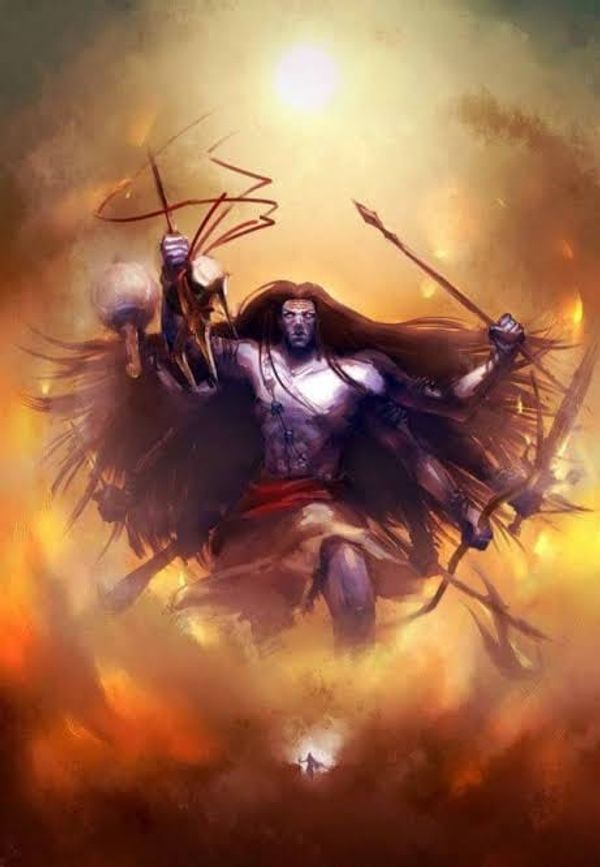
Veerabhadra is generally portrayed as a fierce warrior deity.
Common iconographic features include:
- Thousand arms carrying weapons.
- Three eyes symbolizing divine knowledge.
- Flaming or matted hair.
- Sword and shield.
- Trident (trishula).
- Bow and arrows.
- Serpent ornaments.
- Fierce facial expression.
In South Indian temple sculpture, Virabhadra is frequently depicted standing in a martial posture, emphasizing his role as Shiva's warrior.
In Shaiva traditions, Veerabhadra is regarded as a fierce manifestation of Shiva, embodying his divine wrath and sharing many of his divine powers. Some texts and traditions describe him as possessing the power to destroy the fourteen realms (lokas), while his Sharabha form is considered his most powerful manifestation. These accounts describe his three eyes as representing the Sun, Moon, and Fire, and his wings as being formed from Kali and Bhairava. Within these traditions, Veerabhadra is revered as an immensely powerful deity, second only to Shiva and the principal deities of the Hindu pantheon.
Association with Mars
Certain traditions, particularly those found in the Padma Purana, identify Veerabhadra with Mangala (Mars). According to these accounts, Veerabhadra was born from Lord Shiva's perspiration and wrath to destroy Daksha's sacrifice. After fulfilling his mission, his destructive fury threatened the stability of creation, prompting Shiva to pacify him and transform him into the planetary deity Angaraka (Mars).
As a result, Veerabhadra became associated with the qualities traditionally attributed to Mars in Hindu mythology and Vedic astrology, including courage, strength, valor, energy, and warfare, and was granted an eternal place among the Navagrahas, with devotees believing that his worship bestows health, strength, and longevity.
Worship and Religious Importance
Veerabhadra is especially revered within:
- Shaivite traditions.
- Veerashaiva-Lingayat communities.
- Certain Jat traditions that regard him as an ancestral figure.
- Rural guardian-deity cults in South India.
His worship often emphasizes:
- Courage.
- Protection.
- Removal of obstacles.
- Victory over enemies.
- Spiritual discipline.
Major Temples
Veerabhadra Temple, Lepakshi (Andhra Pradesh)
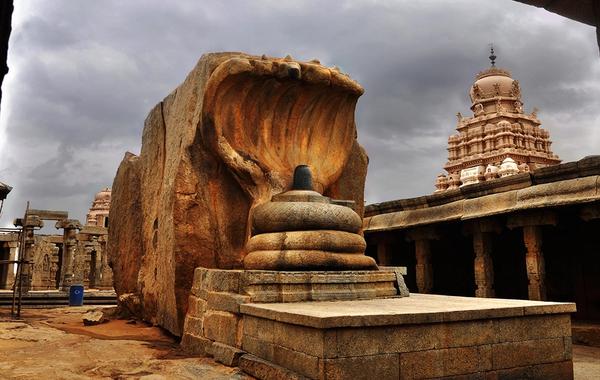
The Veerabhadra Temple at Lepakshi, located in Andhra Pradesh, is the most renowned shrine dedicated to Veerabhadra. Built during the Vijayanagara period between 1530 and 1540 CE by Virupanna Nayaka and Viranna, the temple is celebrated for its magnificent murals, intricate stone carvings, and the famous hanging pillar. It is regarded as one of the finest surviving examples of Vijayanagara architecture and remains an important pilgrimage site for devotees of Shiva.
Veerabhadra Temple, Mukhed (Maharashtra)
The Veerabhadra Temple at Mukhed in Nanded district, Maharashtra, is an important shrine dedicated to Veerabhadra in the Marathwada region. Veerabhadra is worshipped as the Gram Daivat (village deity) of Mukhed and is also revered as the Kuladaivata (family deity) by many families across Maharashtra and neighboring regions.
| Temple | Location | State | Period | Builder/Patron | Significance |
|---|---|---|---|---|---|
| Veerabhadra Temple | Lepakshi | Andhra Pradesh | 1530–1540 CE | Virupanna Nayaka and Viranna under the Vijayanagara Empire | Most famous Veerabhadra temple renowned for Vijayanagara architecture murals and the hanging pillar |
| Bayalu Veerabhadra Swamy Temple | Srisailam | Andhra Pradesh | Ancient | Unknown | Important Shaivite pilgrimage site located near the sacred Srisailam region |
| Veerabhadra Temple | Pattiseema | Andhra Pradesh | Ancient | Unknown | Popular shrine situated on Pattiseema island in the Godavari River |
| Sri Veereswara Swamy Temple | Muramalla | Andhra Pradesh | Ancient | Unknown | Famous for the annual celestial marriage (Kalyanotsavam) of Veereswara Swamy and Bhadrakali |
| Veerabhadra Temple | Yadur | Karnataka | Ancient | Patronized by local rulers and Lingayat community | Major Veerabhadra shrine associated with the Veerashaiva-Lingayat tradition |
| Veerabhadra Swamy Temple | Bonthapally | Telangana | Medieval | Unknown | Important regional pilgrimage center dedicated to Veerabhadra |
| Veerabhadra Temple | Rayachoti | Andhra Pradesh | Medieval | Local rulers | Historic Shaivite temple with strong regional devotion |
| Veerabhadra Temple | Keladi | Karnataka | 16th–17th century CE | Keladi Nayakas | Associated with the Keladi rulers who were followers of Shaivism |
Cultural Legacy
Veerabhadra continues to influence:
- Temple rituals.
- Folk traditions.
- Classical dance performances.
- South Indian sculpture and iconography.
- Regional festivals associated with Shiva worship.
In many regions, he is revered as a symbol of bravery and unwavering loyalty toward dharma.
Historical Interpretation
From a historical perspective, Veerabhadra is understood as a mythological figure whose narratives evolved through centuries of religious literature. Scholars generally interpret the Daksha Yajna story as reflecting tensions between differing ritual traditions and the growing prominence of Shaivism in ancient India.
The figure of Veerabhadra thus serves both as a theological symbol and as an important element in the development of Shaivite religious identity.